
I Ching Divination Methods: Yarrow Stalks & Three Coins
Classical I Ching divination relies on structured chance to turn a focused question into six yin or yang lines. While modern apps often collapse every line into uniform fifty-fifty probabilities, authentic I Ching divination distinguishes sharply between fifty-stalk yarrow sorting and three-coin tossing. Understanding those combinatorial weights clarifies why old yin and old yang appear at different rates and how Zhu Xi's rules interpret moving lines. Below, compare both traditional methods and launch a Web Crypto I Ching session in your browser.
Live Probability Simulator (1,000 Browser Throws)
Compare symmetric Three-Coin odds against the classical asymmetric 50-Stalk Yarrow Stalk ritual
| Line Outcome | Three-Coin Exact | Coins Observed | Yarrow Exact | Yarrow Observed |
|---|---|---|---|---|
| 6 · Old Yin (Changing) | 12.5% (1/8) | 12.5% (125) | 6.25% (1/16) | 6.3% (63) |
| 7 · Young Yang (Stable) | 37.5% (3/8) | 37.5% (375) | 31.25% (5/16) | 31.2% (312) |
| 8 · Young Yin (Stable) | 37.5% (3/8) | 37.5% (375) | 43.75% (7/16) | 43.8% (438) |
| 9 · Old Yang (Changing) | 12.5% (1/8) | 12.5% (125) | 18.75% (3/16) | 18.7% (187) |
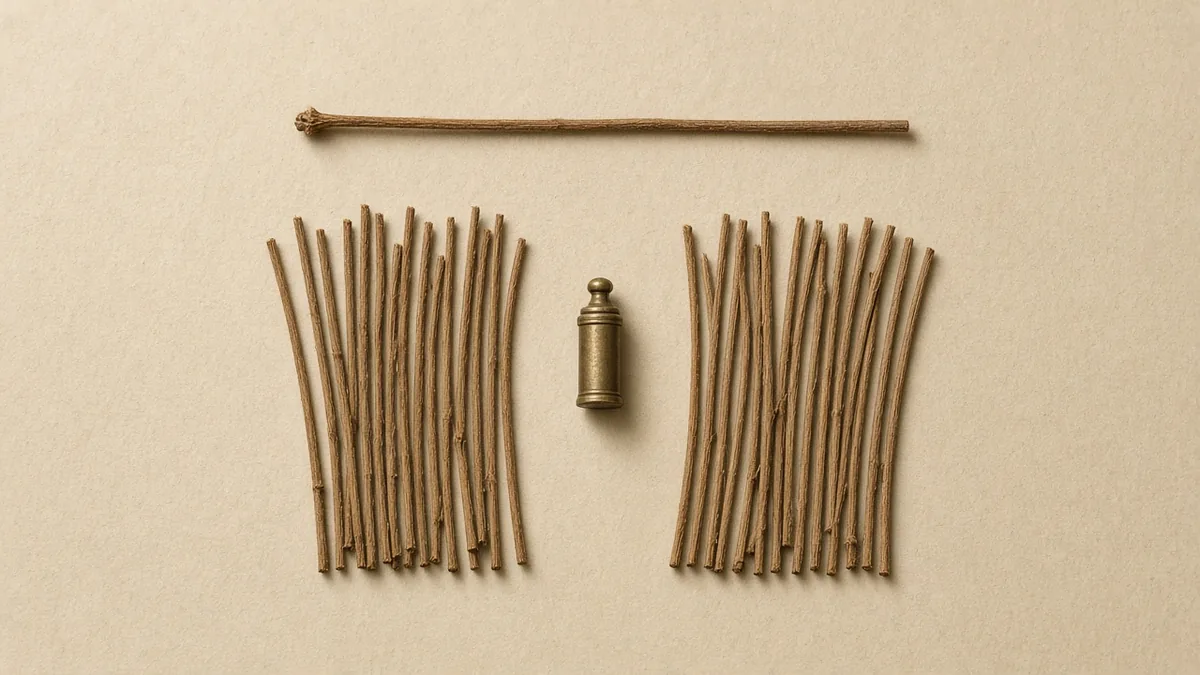
Yarrow Stalk vs. Three-Coin I Ching Divination Odds
In classical I Ching divination, both the three-coin method and 50-stalk Da Yan Shi Cao yarrow produce the exact same 25% overall moving-line probability per line: 1/8 + 1/8 = 25% for coins, and 1/16 + 3/16 = 25% for yarrow. Neither technique yields more changing lines overall. The real classical difference in I Ching divination lies in yarrow's asymmetry. Yarrow makes Old Yang (9, 3/16) three times more likely than Old Yin (6, 1/16), while Young Yin (8, 7/16) is the most common stable line, ahead of Young Yang (7, 5/16). Three coins instead keep the I Ching odds symmetric: 6 and 9 each appear 1/8 of the time, and 7 and 8 each appear 3/8.
Web Crypto Entropy & Zhu Xi Rules in I Ching Divination
Digital I Ching divination should mirror physical probability without hidden bias. Our browser studio uses Web Crypto getRandomValues with rejection sampling to draw uniform integers in 16-part or 8-part space before building each line from bottom to top. Once six lines settle, the caster applies Zhu Xi's classical moving-line framework automatically. With zero moving lines, you consult the primary Guaci; with one or two, you emphasize the changing Yaoci; with three, both Judgments guide the I Ching reading; with four or five, attention shifts to the Zhi Gua; and with six, Qian, Kun, or the transformed Judgment takes precedence in traditional divination.
Try Both I Ching Divination Methods in Your Browser
Choose fifty-stalk yarrow or three-coin tossing on the live casting board, keep every question strictly local in your browser, and inspect exact I Ching probabilities for each drawn line.
Reference Q&A
Frequently Asked Questions
Which I Ching divination method is older: yarrow stalks or three coins?
Fifty-stalk yarrow sorting is the older ritual described in the Shi Yi appendices to the Zhouyi. Three-coin I Ching divination emerged centuries later during the Han and Tang eras as a faster, portable alternative that preserved meaningful moving-line behavior for everyday I Ching practitioners.
Why does yarrow I Ching divination give 1/16 old yin and 3/16 old yang?
During each of the three stalk divisions, remainders of one through four are counted off, and the asymmetric remainder rules make the final sum of six occur in only one of sixteen paths while nine occurs in three of sixteen. That mathematical imbalance defines classical yarrow divination.
Does the three-coin method distort an I Ching reading?
No. In I Ching divination, both three-coin and yarrow methods share the exact same 25% total changing-line chance per line. Three coins do not make an I Ching reading hyperactive; they simply treat Old Yin (6) and Old Yang (9) symmetrically (1/8 each) rather than yarrow's 1:3 ratio.
How does Web Crypto keep online I Ching divination unbiased?
Standard JavaScript math functions are predictable pseudo-random generators unsuitable for serious divination. Web Crypto draws cryptographically strong entropy directly from your operating system and uses modulo-free rejection sampling so every yarrow or coin outcome lands with exact theoretical frequency.
How do I frame a strong question before I Ching divination?
Avoid binary yes-or-no wagers and ask open questions about posture, timing, or underlying dynamics, such as how best to approach a transition. Clear framing helps any casting yield grounded, actionable insight during personal reflection and study.