
Complete Guide to the 64 I Ching Hexagrams
The sixty-four I Ching hexagrams form the structural backbone of the Zhouyi, pairing two three-line Bagua trigrams to map sixty-four archetypal situations across nature and human conduct. Beginning with Qian and Kun and closing with Ji Ji and Wei Ji, these I Ching hexagrams encode complementary patterns of growth, restraint, transition, and renewal. Browse every entry in this library to inspect Guaci judgments, Image commentary, and all 384 individual line texts.
#1 The Creative
乾 · QianUpper Heaven (Qian) over Lower Heaven (Qian)Judgment: Sublime origin, smooth progress, durable benefit through steadfastness.
Image: Heaven moves with tireless vigor; the noble person strengthens character without pause.
Guidance: Lead with clear purpose, match ambition with patience, and stay disciplined as momentum rises.
8×8 Trigram Lookup Matrix
Rows = Lower Trigram (Inner) · Columns = Upper Trigram (Outer) · Pick trigrams directly or click any cell below
| Lower \ Upper | 乾 Qian Heaven | 坤 Kun Earth | 震 Zhen Thunder | 巽 Xun Wind | 坎 Kan Water | 离 Li Fire | 艮 Gen Mountain | 兑 Dui Lake |
|---|---|---|---|---|---|---|---|---|
| 乾 Qian Heaven | ||||||||
| 坤 Kun Earth | ||||||||
| 震 Zhen Thunder | ||||||||
| 巽 Xun Wind | ||||||||
| 坎 Kan Water | ||||||||
| 离 Li Fire | ||||||||
| 艮 Gen Mountain | ||||||||
| 兑 Dui Lake |
All 64 King Wen Hexagrams (64)
#1 The Creative
乾 · Qian
#2 The Receptive
坤 · Kun
#3 Difficulty at the Beginning
屯 · Zhun
#4 Youthful Folly
蒙 · Meng
#5 Waiting
需 · Xu
#6 Conflict
讼 · Song
#7 The Army
师 · Shi
#8 Holding Together
比 · Bi
#9 Small Taming
小畜 · Xiao Chu
#10 Treading
履 · Lu
#11 Peace
泰 · Tai
#12 Standstill
否 · Pi
#13 Fellowship
同人 · Tong Ren
#14 Great Possession
大有 · Da You
#15 Modesty
谦 · Qian
#16 Enthusiasm
豫 · Yu
#17 Following
随 · Sui
#18 Work on the Decayed
蛊 · Gu
#19 Approach
临 · Lin
#20 Contemplation
观 · Guan
#21 Biting Through
噬嗑 · Shi Ke
#22 Grace
贲 · Bi
#23 Splitting Apart
剥 · Bo
#24 Return
复 · Fu
#25 Innocence
无妄 · Wu Wang
#26 Great Taming
大畜 · Da Chu
#27 Nourishment
颐 · Yi
#28 Great Exceeding
大过 · Da Guo
#29 The Abysmal
坎 · Kan
#30 The Clinging
离 · Li
#31 Influence
咸 · Xian
#32 Duration
恒 · Heng
#33 Retreat
遁 · Dun
#34 Great Power
大壮 · Da Zhuang
#35 Progress
晋 · Jin
#36 Darkening of the Light
明夷 · Ming Yi
#37 The Family
家人 · Jia Ren
#38 Opposition
睽 · Kui
#39 Obstruction
蹇 · Jian
#40 Deliverance
解 · Xie
#41 Decrease
损 · Sun
#42 Increase
益 · Yi
#43 Breakthrough
夬 · Guai
#44 Coming to Meet
姤 · Gou
#45 Gathering Together
萃 · Cui
#46 Pushing Upward
升 · Sheng
#47 Oppression
困 · Kun
#48 The Well
井 · Jing
#49 Revolution
革 · Ge
#50 The Cauldron
鼎 · Ding
#51 The Arousing
震 · Zhen
#52 Keeping Still
艮 · Gen
#53 Development
渐 · Jian
#54 The Marrying Maiden
归妹 · Gui Mei
#55 Abundance
丰 · Feng
#56 The Wanderer
旅 · Lu
#57 The Gentle
巽 · Xun
#58 The Joyous
兑 · Dui
#59 Dispersion
涣 · Huan
#60 Limitation
节 · Jie
#61 Inner Truth
中孚 · Zhong Fu
#62 Small Exceeding
小过 · Xiao Guo
#63 After Completion
既济 · Ji Ji
#64 Before Completion
未济 · Wei Ji
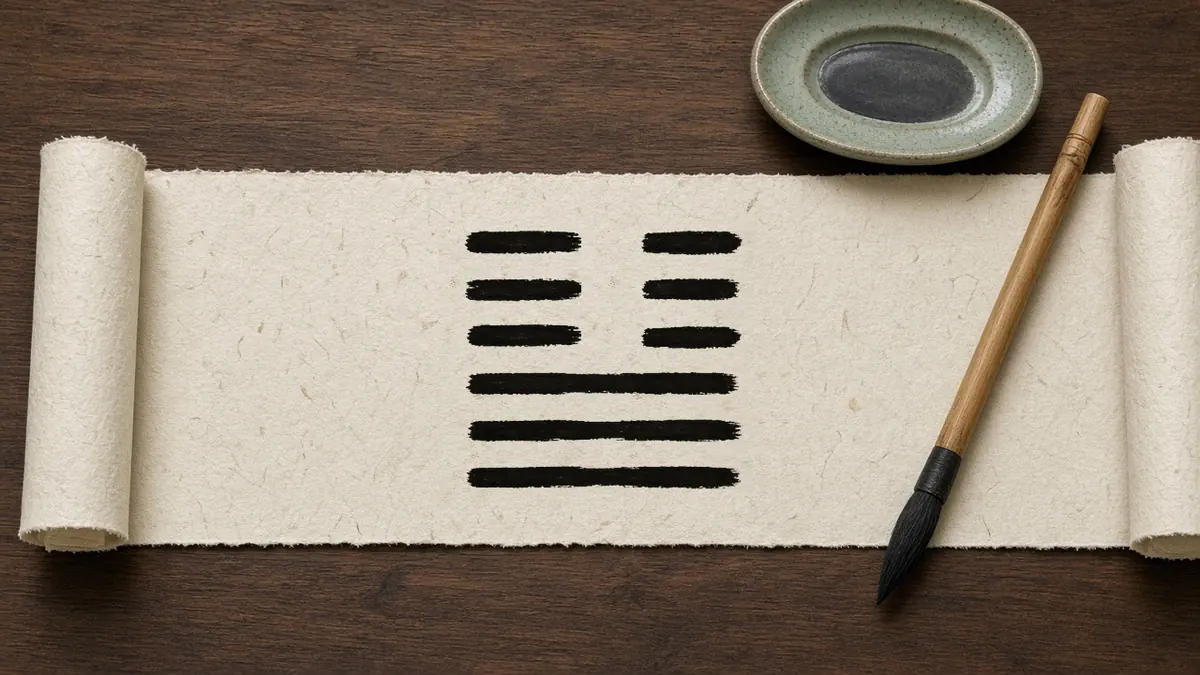
How Trigrams Build the 64 I Ching Hexagrams
Each figure among the I Ching hexagrams stacks a lower inner trigram beneath an upper outer trigram. Eight primary Bagua symbols (Heaven, Earth, Thunder, Wind, Water, Fire, Mountain, and Lake) combine into sixty-four distinct I Ching hexagrams that describe how inner disposition interacts with outward circumstance. Reading lines from bottom to top tracks movement from early stirrings to culmination. Comparing adjacent I Ching hexagrams also clarifies how inverted pairs reflect one another across shifting conditions, while nuclear lines two through five reveal hidden Hu Gua tensions inside the core of the I Ching.
Reading Judgments, Images & Changing Lines in I Ching Hexagrams
Studying I Ching hexagrams effectively means reading three classical textual layers in order. First, the Guaci offers a concise verdict on the overall figure. Second, the Great Image from the Shi Yi commentary draws a practical lesson from the upper and lower trigrams, helping students of I Ching hexagrams apply symbolic insight to daily conduct. Third, the 384 Yaoci describe specific turning points at each rung from line one to line six. When a casting produces moving lines, Zhu Xi's rules show how the primary pattern transforms into a related Zhi Gua, turning static hexagrams into a living map of change across I Ching study.
Explore Every Pattern Across the 64 I Ching Hexagrams
Filter the directory below by trigram, keyword, or King Wen number to study individual I Ching hexagrams in depth, or open the casting studio to draw a live reading.
Reference Q&A
Frequently Asked Questions
How are the 64 I Ching hexagrams ordered in the King Wen sequence?
The King Wen order pairs the I Ching hexagrams into thirty-two complementary couples through inversion or polarity. It opens with Qian and Kun and closes with Ji Ji and Wei Ji to signify ongoing transition in I Ching thought.
What do the six lines inside I Ching hexagrams represent?
Six broken yin or solid yang lines stack from bottom to top to mark developmental stages. Across I Ching hexagrams, line one signals early emergence while line six marks culmination or turning.
How do upper, lower, and nuclear trigrams work in I Ching hexagrams?
Every entry among the I Ching hexagrams pairs a lower inner trigram with an upper outer trigram. Lines two through five also form a hidden Hu Gua revealing quiet forces inside an I Ching reading.
Do I need to memorize all 64 I Ching hexagrams to begin reading?
Not at all. Most beginners start by learning the eight basic Bagua trigrams and letting real questions introduce individual I Ching hexagrams gradually over time, using clear commentaries to compare primary figures and transformed hexagrams step by step.
Why are nuclear and opposite hexagrams listed alongside each entry?
Cross-referencing related figures turns isolated definitions into a coherent system of I Ching hexagrams. Viewing the nuclear Hu Gua, inverted pair, and opposite figure side by side shows how subtle shifts in yin and yang reshape a whole situation.